


By Emily Andrews, Missouri Gateway Green Building Council Executive Director
25 years ago, in 2001, Apple launched iTunes and Wikipedia came into being. A lot has changed in how we access music and information since then. In 2001, Missouri Gateway Green Building Council was one of the first six US Green Building Council chapters to be established. Now there is at least one chapter in every state and many more throughout the world. In 2001, there wasn’t a single LEED certified building in our geographic area — now there are nearly 900. More importantly, the LEED Green Building Rating System, other green building tools, and the people and organizations that make up the green building movement have transformed the market.
Missouri Gateway Green Building Council works with over 100 preK-12 grade schools every year, empowering students, faculty and staff to address sustainability in their buildings, grounds, and curriculum. Nearly 1,000 buildings are reporting their energy and water use annually to the City of St. Louis’ Office of Building Performance through their benchmarking program. Exponentially more buildings locally are tracking their energy and water use. We have local and regional greenhouse gas inventories and climate action plans in place. And concepts like designing for circularity & resiliency, life cycle analysis, net zero energy and carbon buildings, and ESG (Environmental Social Governance) have all become more mainstream. Amazing what can happen in 25 years!
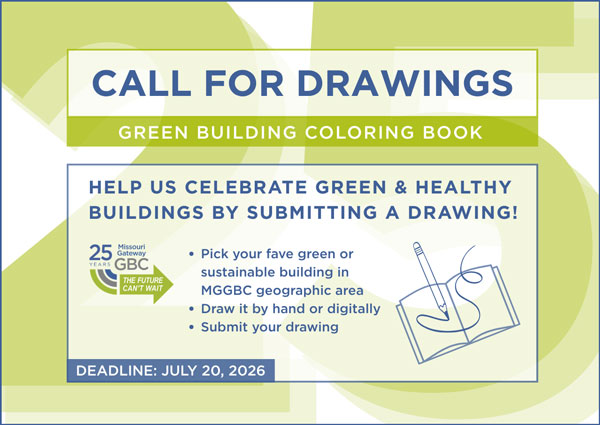
To celebrate our 25-year anniversary, we have launched a call for drawings for a “25 Years of Green Building Coloring Book!” We want to show that green buildings come in all shapes and sizes, are beautifully diverse and help create a built environment that supports and enhances health, equity, resilience, and sustainability for all life and communities. Buildings can have a green certification like LEED, SITES or WELL — or they can have one or more green attributes, such as building and material reuse; sustainable landscaping like native plants and best stormwater management practices; cool and green roofs; solar panels; energy efficient heating, cooling, lighting, and appliances; access to daylight and views; and healthy indoor air quality.
As we look back at our first 25 years, we have built a strong foundation for our next 25. As we celebrate all that we have achieved, we are ready to look forward and create solutions together – because the future can’t wait for us to create (and color) greener and healthier buildings!
Learn more about our Call for Drawings at www.mogreenbuildings.org. Drawings are due July 20, 2026.