



By Dan Zarlenga, Missouri Department of Conservation
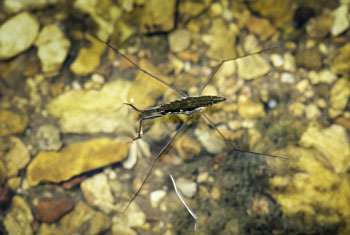
Photo caption: A water strider suspends itself, as if by magic, on the surface of the water. Photo by Jim Rathert, Missouri Department of Conservation.
As Missouri’s waters thaw in March’s warming temperatures and swell with early spring rains, tiny creatures begin performing what looks like a miracle. They walk on water!
It’s not really a miracle though—it’s science.
If you’ve ever paid attention to the surface of ponds, lakes, creeks, streams, or rivers, you’ve probably seen them. Water striders are insects that walk on water. There are many species of water striders in North America, but the most common one found throughout the Show-Me-State is the large water strider. They have elongated bodies, dark brown to black in color, often marked with a white or silvery stripe along each side. Their legs are long and thin, and spread far apart from their bodies.
So just how do water striders appear to defy physics? The secret is in those long legs. If you could examine one through a microscope, you’d see they’re completely covered in very tiny hairs called micro-setae. These hairs repel water. Air is trapped in this hair layer, keeping the legs dry despite being in direct contact with the water.
Water and other liquids possess a quality called surface tension, in which the surface acts like a stretched elastic membrane. It’s caused by cohesive forces between the liquid molecules and creates something like a skin on the water’s surface. If something breaks this “skin”, it sinks. Since the water strider does not disrupt the water’s surface tension, it’s able to walk right on top of it. The wide stance of its legs and even weight distribution aids in the water strider’s ability to resist gravity.
Look closely, and you’ll see small dimples under the strider’s feet, indications the insect is displacing the water but not piercing the surface tension. They can move swiftly too, with some water striders able to propel themselves at 100 body lengths per second.
This is a unique ability that most land-based insects don’t have. And the predatory water striders take advantage of it! If a hapless bug falls into the water, unlike the water strider, it must struggle to keep itself from sinking. The ripples created by this struggle capture the strider’s attention and create a bullseye that it can zero in on.
Upon reaching its helpless prey, the water strider uses a sharp, straw-like mouth part to pierce the unfortunate insect. The strider deposits enzymes that melt the insides of the victim and it is then able to slurp up the nutrients like an insect smoothie. If the kill is especially large, you might see several water striders dining at the same time!
But life is not all about gliding effortlessly around for the water strider. These predators are preyed upon too. Birds and, occasionally, frogs and turtles, dine on them. But water striders are not on the menu for fish, who find the leggy insects distasteful.
While water striders can’t heal diseases, feed the masses, or turn water into wine, they can seem to perform a miracle by walking on water. Once we look a bit closer though, science shows us something even more fascinating.
The strider is not defying nature — it is obeying it perfectly.