


By Jean Ponzi
Fungus Fun Facts
We think of ‘em as mushrooms, but ‘shroomsare reproductive parts thatonly cap the surface.
Fungus is FAR OUT: Most fungi are terrestrial, some are XTreme. Fungal species thrive in deserts, salt concentrations and pitch-dark deep-sea sediments. They’ve survived space travel – Cosmic Rays!
Yet its formal study, Mycology, is a down-to-Earth pursuit.
We’re learning a lot about fungi thanks to curious ordinary folks – and it’s good that this Citizen Science is a thang because Professional Mycologists are in short supply. Opportunity!
No equipment? No barrier. Fungal Field Study is good to go just with boots, tick spray, magnifying lens and loupe and your phone camera. Maybe a notebook. OK, take a pen or pencil too. Still darn do-able.
This Fact is CRAZY: Science classified Fungi as a mere subset of Plants until … 1969. Then Science decided Fungi is (ta-daaa!) a UNIQUE BIOLOGICAL KINGDOM.
I call this scientific evidence of progress, since fungi was first formally described in a treatise published in… 1729. Italian botanist Pier Antonia Micheligets author credit and a nod: Science crowned him its Father of Mycology.
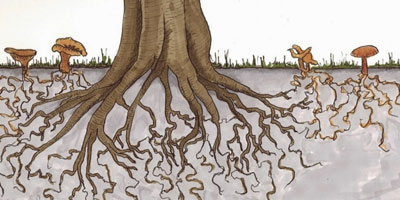
Elegant Exchange: Hairlike fungal hyphae embrace the roots of plants in the vast subterranean symbiosis called Mycorrhiza. Over 90% of all plant species engage in mycorrhizal relationships with fungi, in a proven pact for shared survival.
Fungus helps plant absorb water and minerals, photosynthesizing plant feeds fungus with carbs. Specific species pairings bring a defense element too, since some hyphae and root types are antagonistic.
Plant Kingdom! Fungal Kingdom! Mutual Aid! Life lessons, anyone?
Spotlight on my Fungal Fave: Mutinus caninus, the Dog Stinkhorn. This slender phallic fungus has a dark tip that visually mimics a dunk into glossy offal. When you whiff it: Ooh la la! C’est merde!
Fungal Form has Motive: Dog Stinkhorn is a fragile column, yellow or pink, curving to a point. Poking up from wood chips, into Pollinator space. A neon-orange tip is covered in slimy, spore-bearing Gleba. Thisucky olivey-brown stuff, with odor most foul, lingers on waves of summer heat in one of Nature’s many brilliant reproductive schemes.
The Stinkhorn “dog” attracts Flies, life’s dung-loving pollinators. They feast, leg-deep, on the stinky sticky spores, then wing away to litter Mutinus caninus into new locales.
Bottom Line: Funk FUNCTIONS! Eco-Logical merit mushrooms for mycelial miles through our fabulous Earth’s profound underground.
Green Jean Ponzi is a longtime local voice for Earth, through her work for the EarthWays Center of Missouri Botanical Garden and community radio features, now on our new internet station Community Radio STL. Dig her Earthworms Castings commentaries at www.CRSTL.FM.
Word Count: 431, including fruit salad