



By Dan Zarlenga, Missouri Department of Conservation
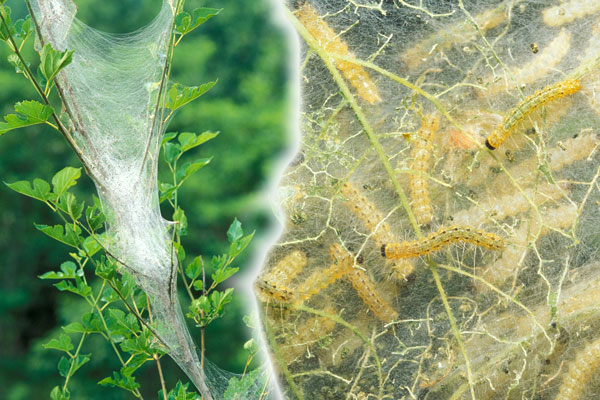
Photo caption: Not what it appears, more than it seems; a colony of fall webworms at work. Image courtesy of the Missouri Department of Conservation
Some things are not what they appear. Some are more than they seem.
You’re walking along on a balmy July day and you spy a magnificent hickory tree. Entwined around the end of a branch is a mysterious, silken web. At first, you might assume that a spider was busy at work spinning its web to catch an unsuspecting insect.
What you’re really seeing is a tiny, climate-controlled society built by a moth—the fall web worm moth.
The webworm is a white moth, but often shows grayish brown or black spots, usually wedge or rectangularly shaped. Like so many other moths, fall webworms are nocturnal and are commonly found around lights at night.
They begin construction of their tent-shaped web structures in July, so you’re likely to start seeing them now. By August and September, after more construction time, the webs grow to be even more conspicuous on trees such as pecan, walnut, persimmon, hickory, and sycamore. Their name comes from the fact that these tents become especially noticeable as summer turns toward fall.
So, is this web a trap for prey insects, as it might seem at first glance? Not at all. The structure is actually a summer home built with a view high in the branches. The architects are the webworm caterpillars, not the adults, which explains the “worm” part of the name.
Wrapped around the leaves of the tree, the tent acts as a protective refuge. It enables the fall web worm caterpillars to dine on the leaves while safely shielded from the outside world. These larvae are surprisingly social—a trait extremely rare among caterpillars. Most species are solitary and individualistic. Not these; hundreds of siblings live, eat, and grow together in a home they all work in harmony to maintain. It’s a whole family colony of hungry caterpillars under one silken roof.
The web not only protects the growing webworm caterpillars from voracious predators. The silken walls are amazingly capable of creating and maintaining a climate-controlled environment for the inhabitants too. No thermostats, no air com pressors—just a naturally engineered system that helps moderate Missouri’s summertime heat and humidity.
But it’s not always an easy summer for these caterpillars. Some predatory wasps can still tear into the tents to get at the larvae, and spiders are occasionally seen building their webs within the webworm tents. Even nature’s best engineering has limits.
While the webs might be a remarkable achievement, the caterpillars often get a negative reputation for defoliating and destroying the trees they feed on. However, this is not the case. It’s true a colony can denude the tree’s branches, but nature synchronizes it all with impeccable timing. This defoliation occurs late in the season, when many trees are preparing to drop their leaves for autumn anyway. Therefore, the webworms rarely cause any severe damage to healthy trees.
A structure that appears like a simple spider web is more than it seems; it’s an elaborate nursery, dining room, and climate-controlled shelter all in one. Nature often rewards those willing to take a closer look.