



By Dan Zarlenga, Missouri Department of Conservation
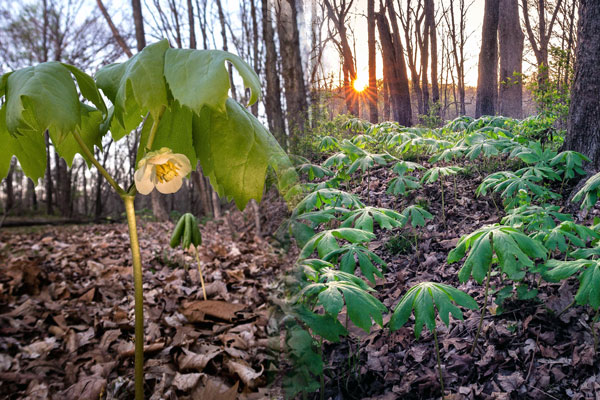
Photo caption: Mayapples, from above and below. Photo by Dan Zarlenga.
“One of the rain’s greatest magic is that it suddenly makes thousands of umbrellas appear out of nowhere!” — Mehmet Murat ildan, playwright, novelist, observer of nature. Go on an exploration in a forest this month. The rains of departing April have dampened its floor, adding a softness to your footsteps and a musky smell to the air. And in response, a multitude of tiny green umbrellas have unfurled from the ground.
This army of miniature umbrellas is actually a colony of mayapples. Bend down and look closer. The wide, palmately lobed leaves seem as if they’ve been plucked from a tropical rainforest. A whole cluster of mayapples is an impressive sight.
But mayapples have more to offer than the obvious march of green marionettes. Peer beneath the umbrella and you might just see a secret surprise. From late April and into May, you could discover a dainty, white flower there.
It’s a surprise you won’t find under every leaf, however, because not all of them flower. Most are single-stemmed plants with one leaf. These are juveniles that can’t bloom. It’s a rite of passage among mayapples—only plants that eventually fork into two leaves gain the ability to blossom. This makes the discovery of a mayapple flower an especially charming occurrence.
Those blooms appear to nod beneath the leaves and are white, with waxy, spreading petals. The center pistil is green and clublike. A rare pink-flowering form also can sometimes be found. Flowering mayapples will produce fruits later in the summer.
But to really know the mayapple, you must go even deeper. The mass of green umbrellas you see on the surface are all likely part of just one organism below.
The mayapple plant spreads through underground rhizomes, which are like specialized stems that grow horizontally just below the surface. Rhizomes are essentially storage organs, stocking up on starches and proteins that nourish the plant and help it propagate. This underground structure remains from year to year, even as the surface leaves, flowers, and fruits come and go with the change of seasons.
So, the showy cover of ephemeral umbrellas hides the real heart of the plant below. An army of green soldiers commanded by a spreading botanical empire hidden from view.
Even more amazing is that the mayapples conceal yet another special secret. Their roots, rhizomes, and leaves contain a compound called podophyllotoxin. This substance is used in a process that produces cancer-treating drugs, which prevent the invasive cells from dividing and spreading.
It seems the little green army of leaves truly does have the power to vanquish the mighty.
Perhaps you might look at the common mayapple a bit differently next time you see a cluster on the forest floor. Those little green umbrellas hide some remarkable secrets—from a chance demure white flower to compounds used to fight cancer. Yet their fleeting appearance in spring also reveals something living that was never really gone.