



By Dan Zarlenga, Missouri Department of Conservation
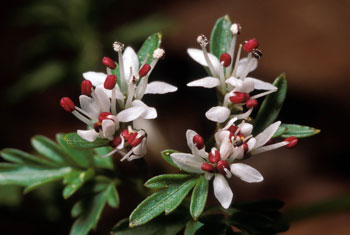
Photo caption: The harbinger of spring is one of very first Missouri wildflowers to hint at the arrival of spring. Photo by Jim Rathert, Missouri Department of Conservation.
There was a time when the dawn was ushered in by the beautiful goddess, Eos. The earliest rays of dawn passed to the Earth through her rosy fingers. The beams brought new life to the land, awakened by the light of her brother Helios—the sun. The appearance of Eos symbolized the break of day, the first light of rebirth and renewal.
So, the ancient Greek mythology goes. The great poet Homer called her Erigenia, Greek for “early born”. Each morning, Eos opened the gates of heaven to release the sun onto the land. She is often represented as adorned with wings and golden arms, her rosy fingers symbolizing the warming light of dawn.
The spirit of Eos lives still in a tiny flower you might just start seeing right about now. What could be the significance of a plant that typically blooms at a height of just two- to- three- inches, and never grows more than eight inches in total? Much like the Greek goddess, it heralds the dawn of a new season.
The harbinger of spring is a flower which can bloom in Missouri even during the icy grip of late January. It’s commonly seen by February in bottomland and moist upland forests, often in ravines and valleys, and along streams and rivers. It can be found throughout the Show-Me State.
The plant’s scientific designation is Erigenia bulbosa, inspired by Homer’s nickname for the Greek goddess of the dawn. Like Eos, the harbinger of spring ushers in the rebirth and renewal to come. The “bulbosa” part of the name describes the plant’s tuberous roots.
Harbinger of spring flowers are tiny white blossoms, arranged in very small, rounded clusters. They’re shaped a bit like an umbrella. The flower’s dark reddish-brown anthers stand out to create colorful accents, evoking the rosy fingers of goddess Eos.
Harbinger of Spring is a member of the carrot family and related to Queen Anne’s lace, water hemlock, parsnip, parsley, cilantro/coriander, celery, dill, fennel, cumin, and anise.
This species is one of the early-spring ephemeral wood land wildflowers. It must emerge, bloom, and perpetuate itself before the trees leaf out and block the light of Helios. The reproductive mission of the harbinger of spring is enabled by the pollination work of a wide variety of bees and flies.
While most loved as one of the earliest signs of spring, the bulbs of the plant are actually edible, both cooked and raw. As with many wild plants, proper identification is essential. The Cherokee were also known to chew parts of the harbinger of spring to relieve toothaches.
The humble harbinger of spring may not be as dramatic as the lovely goddess for which it is named. The one who ascended to the sky in a chariot each morning, opening up the gates of heaven to spread the light of the dawn upon the land. The plant’s more subtle beauty still makes it worth seeking out. It truly is one of the “early born” of spring, with miniature rosy fingers that beckon in the warmth, light, and a season of renewal.